[us_image image=”65″ align=”center” link=”%7B%22url%22%3A%22%22%7D”]
Check out our Year at a Glance for dates and pricing for all PD events for the 2024-25 school year! Check back often for more specifics!
CMEA has formed a STEAM Committee to explore and provide resources for teachers to better advocate to their districts on the connections between music and math and science topics.
Elementary School
Middle School/Lower High School
MORE LESSONS PROVIDED BY CT Arts Admin. Association (CAAA)!
RESOURCES
Institute for Arts Integration and STEAM
Get certified in Arts Integration and STEAM!
This is a new committee so resources are still being gathered. Check back often for new lessons, websites, and standards resources.
Interested in joining the committee or have resources/lessons you could share? Please email the CMEA Professional Development Chair at prof-dev@cmea.org
CMEA’s new Mentorship Program is officially launching this fall for this school year! The program will connect first- and second-year teachers with veteran music educators with similar areas of expertise to work with throughout the year.
What will the program look like?
All mentors will meet in early October to discuss expectations, goals, and values of the program
First and second year teachers will have the chance to sign up through the end of October
Mentors will be assigned, and the program will launch with a kickoff event in October/November
Mentees will have access to their mentors throughout the year for support based on their needs along with a whole group event in February and devoted time at the In-Service Conference.
In this climate of constant change, the Mentor Program will work to provide an extra support system for first- and second-year teachers to collaborate, share challenges, hear best practices, and engage in our statewide network of music educators, all at their own pace and convenience.
Please feel free to email Hannah Fraser, CMEA Membership Chair, with any questions at membership@cmea.org
Do you have a job opening in your school or district? Let us know so we can include them on our Job Board!
Email a brief description and application links to us at info@cmea.org.
Use the Username and Password you received via email. ALL members will be using the same username/password.
Didn’t get the login instructions email? Ask a colleague who did receive it or send an email to the CMEA office at executive@nafme.org and we will send the login to you. Please write “LOGIN” in the subject line.
About 35-40,000 years ago, humans began carving flutes out of bone. Could it have been a means of communication or were the flutes simply used to entertain? Most likely we’ll never know the answer but, curiously, humans were also painting the walls of caves. Why would these early visual and auditory expressions be part of life when avoiding being lunch for a hungry saber tooth would surely have been more critical?
We’re all familiar with Maslow’s hierarchy and understand that primary needs such as food and safety are critical to the human’s higher cognitive and affective functions. Despite this, the arts have been central to our human psyche in every culture and society since the beginning of recorded time. For those of us who are musicians and music educators, then, the rationale for including music and art in education seems obvious. Unfortunately, for others, music and art have been minimalized in favor of the “essential core subjects” that we must have to function in life. I would argue that what music and the arts teach is essential for functioning successfully in life. So, the purpose of this article is to provide four strategic points that we can share with parents, administrators, students, and colleagues as advocacy for music in our schools. These points are: 1. Current Brain Research; 2. Literacy Connections; 3. Developing life skills (21st century skills); and, 4. Building Community.
Current Brain Research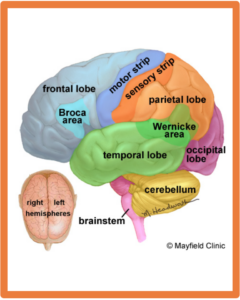
Understanding how the human brain works is not a new concept. Brains were stolen from gravesites as early as the 1500s so scientists could study this complex mass of gray matter more closely. In the 1600’s two important discoveries were made by medical doctors. Paul Broca found that the vocalizations we make are produced in a section of the brain close to the motor cortex. This area, named “Broca’s Area” works in sync with another area named after neuropathologist Carl Wernicke. Wernicke’s area enables us to make sense of the sounds we hear and produce. In order to speak or sing, we need both areas to function correctly. If we read symbols by verbally or physically translating the symbols to sound (such as singing text or playing musical pitches) we also add the visual, memory, and motor systems to the mix. Engaging in music, then, activates large portions of the brain, strengthening neuro-connections and refining functionality. Increasingly precise technology is helping us understand more each day about these processes and the importance of music learning in multiple areas of study including early language acquisition, development of prosodic skills (reading and speaking with appropriate pitch, rhythmic, stress, and pauses), discriminating fine-tuned sounds, hearing and speech in aging, autism, and hearing and speech impairments.
Literacy Connections
As a result of many clinical research studies worldwide, we know that the process of speaking, singing, and reading incorporates similar neurological areas. Researchers continue to find that language and auditory neurological processing that is essential for being able to read and properly communicate is strengthened by musical study. Phonological awareness (a global understanding of sound) and phonemic awareness (the understanding of the smallest units of sound) are those discreet skills that we teach every day in music. We ask our students to find a main theme, determine whether pitches are rising or falling, identify and match pitch, articulate the beginnings and endings of phrases, and translate the affective symbols in a music score into sensitive musical expression. All of these skills are necessary for reading literacy. In fact, the ability to read with expression, including pitch variation and rhythmic flow, has been found to be a major contributor to reading comprehension later. Some of the more recent research explores steady beat and rhythmic skills in relation to reading literacy. Clearly, these are critical skills in music, but we are learning that the ability to internalize a steady beat is also needed for reading text as well.
Development of Life Skills
Educational testing has been focused primarily on reading and mathematics for a decade or more. While no one would argue that these are critically important in every child’s education, we are beginning to return to a more holistic approach to teaching and learning. Our teacher evaluation systems expect us to solicit high order thinking and promote opportunities for collaborative problem solving, verbal and written communication, and encourage self-regulation and responsibility. Music study is the perfect conduit for developing these abilities that some call 21st century skills, or life skills. I would go so far as to say that while the brain and literacy research are strongly compelling, developing life skills or workplace skills may be as convincing an argument for music study, particularly with parents. The chart below was created for our book the Music and Literacy Connection, 2nd edition (2014) by Brian Weidner, a former music supervisor in Illinois. Brian wrote a chapter for us that highlights secondary music ensembles. In it he created a side-by-side chart that relates common music practice with the types of life skills (termed executive functions by neuroscientists and psychologists) that are being developed.
Executive Functions and 21st Century Skills: A Side-by-Side Comparison
| Executive function | 21st century skills | Practice in the music classroom |
| Goal development | Initiative and self-direction Collaboration Productivity and accountability |
Ensemble goal setting Weekly self-assessment Collaborative blogging |
| Prioritization | Critical thinking & Problem solving
Communication Collaboration Leadership & responsibility |
Collaborative rehearsal plan
Sectional inventory Student self-evaluation |
| Organization | Critical thinking & problem solving
Communication Productivity & accountability |
Graphic organizer
Student-created music dictionary Sight motive Pre-sight reading inventory |
| Reasoning | Critical thinking & problem solving
Creativity Information literacy |
Student led mini-clinic
Contextual definition of unfamiliar terms |
| Judgment | Critical thinking & problem solving
Initiative & self-direction Productivity & accountability Leadership & responsibility |
Concert critique
Peer lesson Music style interpretation
|
| Deductive/Inductive thinking | Critical thinking & problem solving
Creativity Information literacy Media literacy Communication & technology literacy |
Student researched program note
Thematic concert program Think/Pair/Share Comparative sight reading Variation composition
|
| Critical analysis | Critical thinking & problem solving
Creativity Innovation Information literacy Media literacy Communication & technology literacy |
Score analysis
Error detection and correction Listening analysis Comparative listening |
| Cognitive flexibility | Critical thinking & problem solving
Creativity Innovation Flexibility & adaptability |
Speed dating
Sing-Play-Critique-Repeat Varied performance practice |
| Attention | Productivity & accountability
Leadership & responsibility |
Rehearsal flow chart
Exit slip |
| Emotional control | Social & cross-cultural skills
Leadership & responsibility |
Program justification
Rehearsal reaction Descriptive practice journal
|
| Inhibition control | Social & cross-cultural skills
Initiative & self-direction |
Solo preparation
|
| Self-regulation | Flexibility & adaptability
Initiative & self-direction |
Student-led small ensemble
Sectional leadership Practice plan proposal |
In advocating for music education in schools, the breadth of learning and skill development that may be acquired by music study is extraordinary. The life skills are also learned as part of team sports and other social activities, but music study (and I would add, performing arts in general) is multi-faceted in ways that no other endeavor can approach.
Building and Educating Community
Finally, social media and the constant barrage of information that confronts us on a moment to moment basis make us acutely aware of our immediate community and the world. More than ever, we need to come together in civil and social settings to learn how to be respectful and accepting of each other. Our music programs provide these opportunities within a classroom, across the school, and into the community. These experiences enlighten our students and help them develop a sense of place and an understanding of diversity and humanity. The school, led by the music programs, is often the center of our communities. But we cannot allow expectations for music programs to be taken for granted. We must constantly educate our peers, administrators, and parents about the process that our students go through to prepare for a performance. When they attend a performance they see only the end product. What have the students learned that is so valuable that it should never be eliminated from any grade level? Here is a short list that begins to sum it up:
In summary
Remember that as a music educator in your school and community, it is your responsibility to advocate for your programs. Make sure to cite research and great quotes in your programs, on your website, in your e-mail signature file, and when you address parents and administrators. Help them and your students understand what they are learning. Teaching musicality in the broadest sense is our goal and we must dedicate ourselves to teaching it well. Our art form is a critical component of a well-rounded education in the new federal law, Every Student Succeeds Act (ESSA). You can find excellent resources on the NAfME website for this and more rich advocacy resources as well. Start this school year knowing that you make a difference for your students in many different capacities. As Michelle Obama (2009) so eloquently said:
You’ll learn that if you believe in yourself and put in your best effort, that there’s nothing that you can’t achieve. And those aren’t just lessons about music. These are really lessons about life.
Dr. Dee Hansen, Professor, Music Education
Director of Graduate Studies
The Hartt School, University of Hartford